
Home / Blog / Application Security
Java4Shell (CVE-2026-114938): what the critical OpenJDK RCE means for you
A short, malformed Base64 string can corrupt memory in OpenJDK's decoder and, in tested products, lead to remote code execution without a login. Here is who is exposed and what to do today.
What happened
Calif, the security firm that found the bug, says it went from first spotting the flaw to a working exploit in about three hours, including roughly one hour for its AI tooling to find it, for under $200 in model costs (Endor Labs). That number alone is worth sitting with: the cost of finding a critical Java bug just dropped by orders of magnitude.
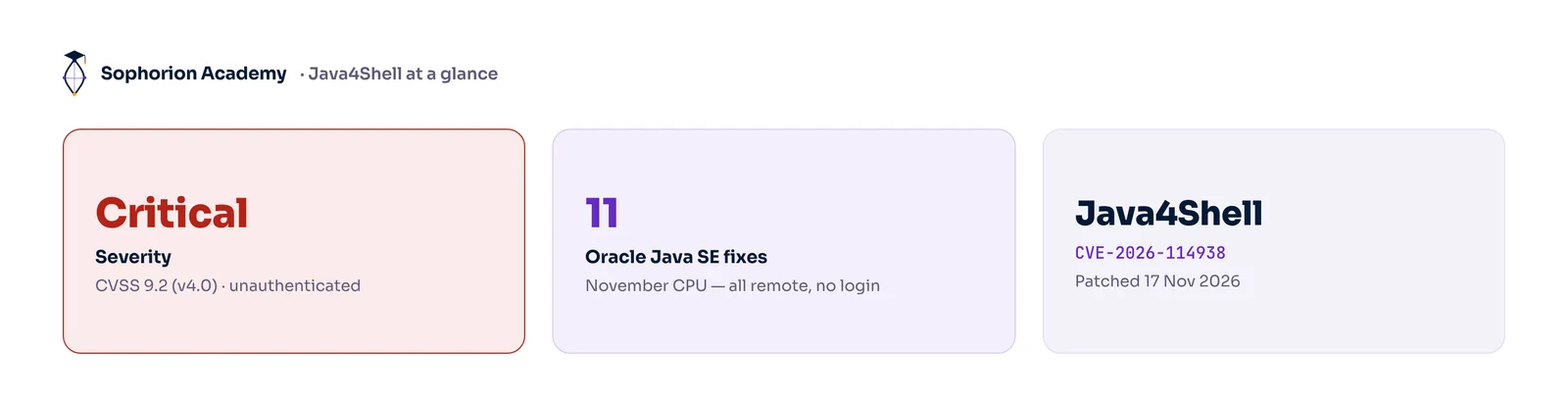
The vulnerability, nicknamed Java4Shell and tracked as CVE-2026-114938, is a critical memory-corruption bug in OpenJDK’s hardware-accelerated Base64 decoder. Calif rates it 9.2 under CVSS 4.0. Oracle scores the same flaw 8.1 under the older CVSS 3.1 scale. The two numbers come from different scales, so don’t compare them directly with scores you have seen elsewhere (Tenable).
South Korea’s National Cyber Security Center had already warned public institutions about an unauthenticated Java RCE a day before the public disclosure, a sign the bug was moving through private channels first (Astra). Calif says the bug leaked ahead of its planned coordinated disclosure, which is why full details landed alongside Oracle’s patch rather than after a quieter rollout (The Hacker News). As of 18 November it was not in CISA’s Known Exploited Vulnerabilities catalogue, but security vendors are urging organisations to patch now (Ostorlab).
Timeline
| Date | Event |
|---|---|
| 14 Oct 2026 | The fix (JDK-8393212, titled “Base64 optimization improvements”) is committed to OpenJDK under embargo |
| 16 Nov 2026 | South Korea’s NCSC advises public institutions of an unauthenticated Java RCE |
| 17 Nov 2026 | Oracle ships its November update: 11 Java SE fixes, all remotely exploitable without authentication |
| 17 Nov 2026 | Calif publishes its Java4Shell write-up after the bug leaks ahead of schedule |
| 17 Nov 2026 | Cisco Talos, Qualys, SentinelOne and others publish advisories |
Sources: Cisco Talos, SentinelOne
Who’s affected
Exposure depends on three things together: the Java version, the processor, and whether the application passes attacker-controlled data through java.util.Base64’s decoder (Qualys).
| Condition | Affected | Not affected |
|---|---|---|
| Java version | OpenJDK-based builds from 17.0.6 onward, including 21, 25 and 27; also Oracle Java SE 8 Enterprise Performance Pack 8u511b33-perf | 17.0.0 to 17.0.5; standard Java 8 and 11 (no x86 decode stub exists before these) |
| Processor | x86-64 with AVX-512 VBMI: Intel Xeon from Ice Lake through Granite Rapids, AMD EPYC and Ryzen from Zen 4 onward | ARM64 (including AWS Graviton and Apple silicon); x86-64 without AVX-512 VBMI (for example Skylake-SP, Cascade Lake, pre-Zen 4 AMD) |
| Library path | The standard java.util.Base64 decoder | The MIME variant, and any Base64 library that doesn’t call java.util.Base64 |
The version condition covers every OpenJDK-based distribution: Oracle Java SE, Eclipse Temurin, Amazon Corretto, Microsoft Build of OpenJDK, Azul Zulu, BellSoft Liberica, SAP SapMachine and Red Hat’s OpenJDK among them (Qualys).
Two things are worth knowing before you scope this. Many products bundle their own JDK that OS-level updates never touch, so check what each service actually runs, not what java -version reports on your shell’s PATH. And the trigger is short: as little as 65 characters of malformed Base64 reaches the vulnerable path on Java 21, 25 and 27, and 129 characters on Java 17 (Endor Labs).
In practice, this reaches widely deployed Java applications such as Jira, Jenkins, Keycloak, Confluence and Artifactory, anywhere they run on an affected runtime and CPU (Aviatrix). If your stack runs Java 17 or later on modern cloud infrastructure, assume you need to check rather than assume you’re clear.
Why it’s serious
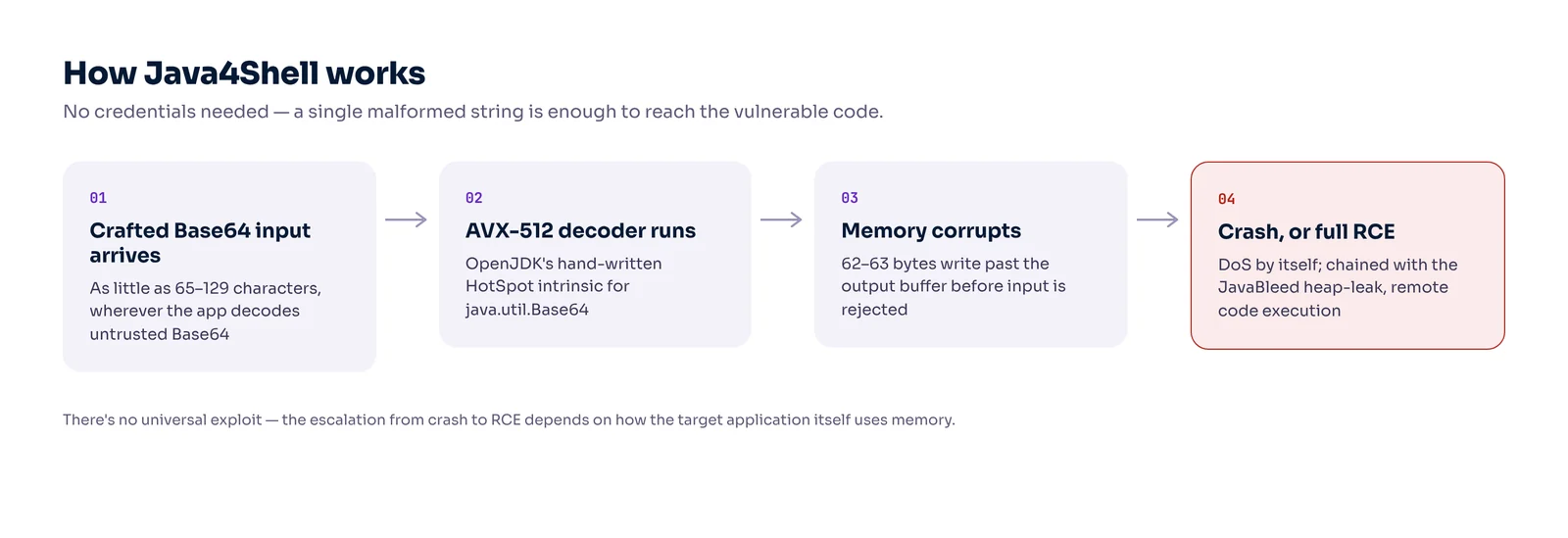
The bug sits in hand-written assembly that speeds up Base64 decoding with AVX-512 instructions. A short, specifically malformed input makes that code write 62 or 63 bytes past the end of its output buffer, and the write happens before Java gets the chance to reject the input as invalid (Endor Labs).
On its own, that’s a crash. The overwritten bytes are a fixed pattern rather than attacker-chosen, so the immediate effect is heap corruption and a JVM crash: an unauthenticated denial of service against any reachable vulnerable service. Calif’s escalation to full remote code execution depends on how the target application uses memory. It chains the overflow with a heap-leak technique it calls JavaBleed, repairs the corrupted object headers so the JVM keeps running, grooms the heap into a chosen layout, then redirects the writes at the JVM’s compiled-code cache (Endor Labs). There’s no universal exploit. Each target application needs its own chain, which is why confirmed impact is product-specific rather than “every Java server, everywhere”.
Researchers have demonstrated remote code execution, in default configurations, against:
| Access required | Products |
|---|---|
| None (pre-authentication) | Keycloak, Atlassian Jira, Atlassian Confluence, JFrog Artifactory, Jenkins, PingFederate |
| Authenticated user | Apache Kafka Broker, Apache Solr, Elasticsearch, Gerrit, Netflix Spinnaker |
Sources: Qualys, SentinelOne
Researchers say these lists aren’t exhaustive: they have also reached RCE in sample applications built on Apache Struts and Spring Boot (Qualys).
For context, last month’s PHP2Shell, another leaked runtime RCE, also scored 9.2 under CVSS 4.0 and was later added to CISA’s Known Exploited Vulnerabilities catalogue (Endor Labs). As of the disclosure, no in-the-wild exploitation of Java4Shell had been confirmed. But the root cause and exploitation technique are now public, and Calif’s own “$200, three hours” experience is a preview of how fast that usually changes.
What to do now
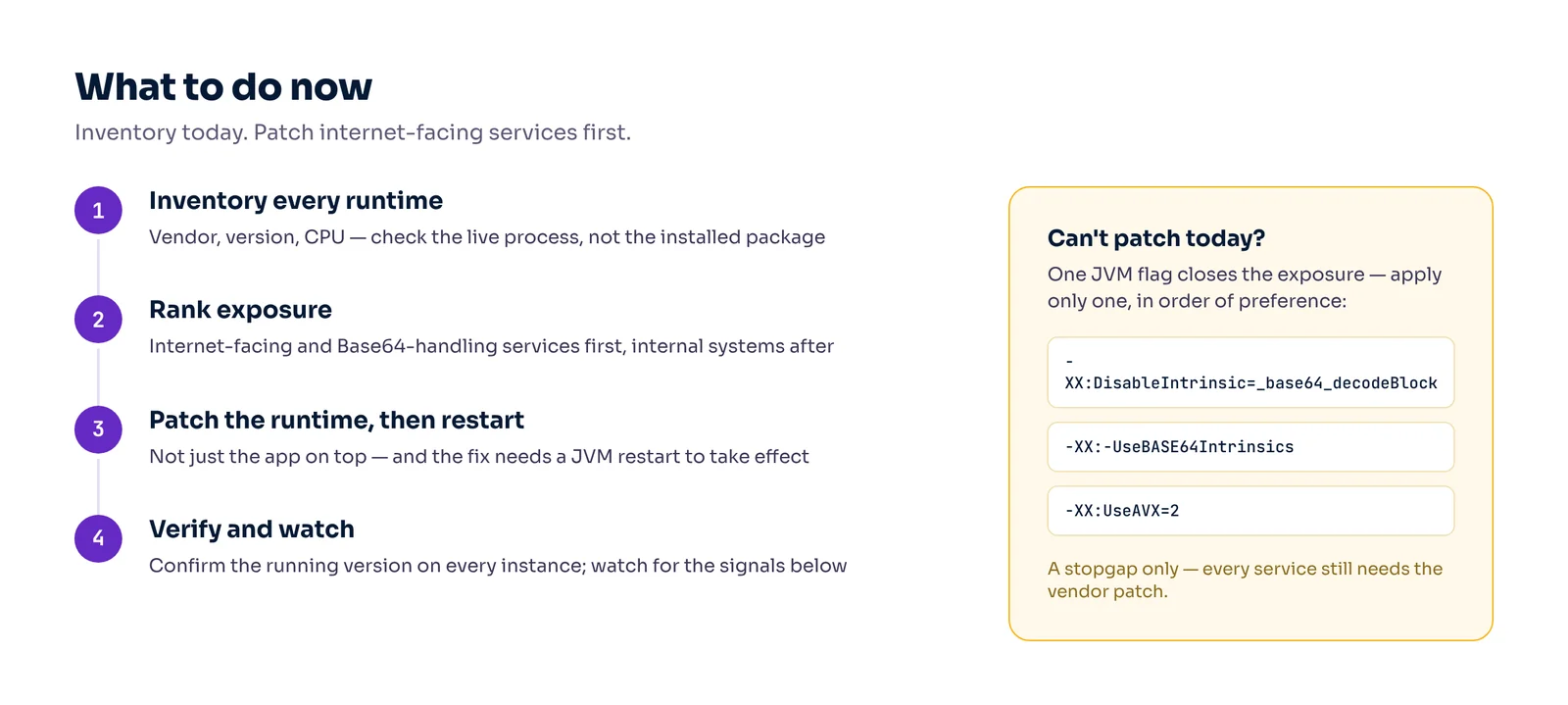
1. Inventory the runtime each service actually uses, not what your shell reports. Jenkins, Jira, Confluence, Keycloak and Elasticsearch, among others, often bundle their own JDK that OS-level updates never touch (Endor Labs). On Linux, check the live process rather than the installed package:
ps -eo pid,args | grep '[j]ava'
jcmd <pid> VM.version
grep -o -w -m1 'avx512vbmi' /proc/cpuinfo
2. Patch the runtime, not just the application on top of it.
| Oracle Java SE | Fixed build |
|---|---|
| 8 Enterprise Performance Pack | 8u513-perf |
| 17 | 17.0.21.1 |
| 21 | 21.0.13.1 |
| 25 | 25.0.5.1 |
| 27 | 27.0.1.1 |
Other OpenJDK vendors ship on their own schedules; Amazon’s Corretto 17.0.21.1.2 already carries the fix. Confirm that your distribution’s own advisory names CVE-2026-114938 before trusting a version number alone (Qualys).
3. Can’t patch today? One JVM flag closes the exposure. Apply only one, in this order of preference:
| Flag | Effect |
|---|---|
-XX:+UnlockDiagnosticVMOptions -XX:DisableIntrinsic=_base64_decodeBlock | Narrowest: disables only the vulnerable decode intrinsic |
-XX:-UseBASE64Intrinsics | Disables the Base64 encode and decode intrinsics and falls back to the standard decoder |
-XX:UseAVX=2 | Disables all AVX-512 code paths, with a broader performance cost. x86-64 only: ARM JVMs refuse to start with this flag |
Restart every Java process after applying a flag or a patch. Neither takes effect until the JVM restarts, so verify the running process, not just the installed package (Qualys).
4. Reduce exposure while you wait. Take identity, build and collaboration consoles off the open internet, or put them behind a VPN, until they’re patched.
5. Watch for these signals:
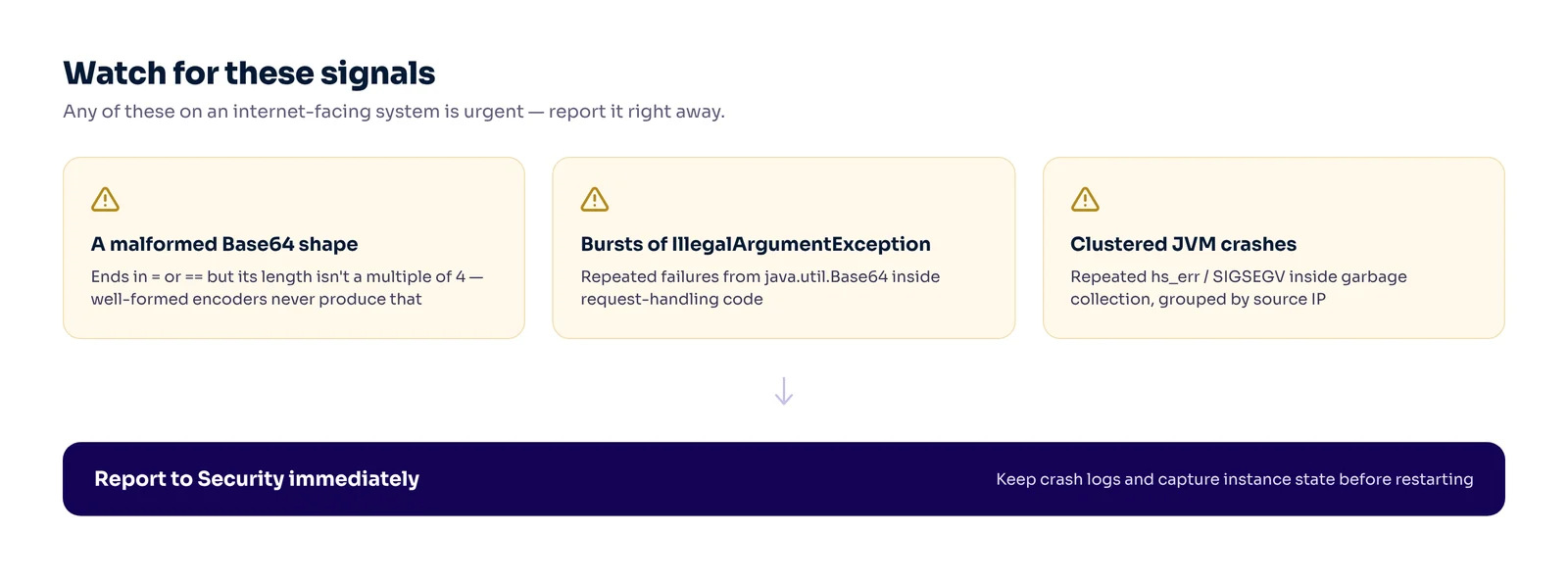
- A Base64 field ending in
=or==whose length isn’t a multiple of 4. Well-formed encoders never produce that shape (SentinelOne). - Bursts of
IllegalArgumentExceptionfromjava.util.Base64in request-handling code. - Repeated JVM crashes (
hs_errfiles, SIGSEGV) inside garbage-collection routines, clustered by source IP (Endor Labs).
6. Work in priority order: internet-facing identity providers first (Keycloak, PingFederate), then internet-facing Jira, Confluence, Jenkins and Artifactory, then other internet-facing Java services that handle logins or file uploads, then internal systems. Give everything still waiting on a vendor build an owner and a deadline.
The AppSec takeaway
Java4Shell is a reminder of something easy to forget between incidents: the runtime underneath your code is part of your attack surface, not a solved problem you can stop thinking about. Patching discipline, dependency inventory, and knowing exactly which CPU features and library versions your production stack touches are AppSec fundamentals. They are baseline skills, not advanced topics.
This is the kind of real-world case we work through hands-on in Sophorion Academy’s Application Security and Secure SDLC tracks: reading an advisory like this one, scoping actual exposure instead of guessing, and building the patching and monitoring habits that catch the next one faster.
Calif’s three-hour, under-$200 path from discovery to exploit is its own lesson. AI-assisted vulnerability research is making bugs like this faster and cheaper to find, which is exactly why the defensive habits (inventory, patching discipline, reading past the headline to the actual exposure) have to get faster too.